



The campaign to save Queensbury Tunnel is an excellent example of how local people coming together with a shared vision can form an incredibly powerful voice when faced with short-sighted political decisions.
Background: An Engineering Marvel
Built by Great Northern Railway and opened in 1878, Queensbury Tunnel stretches 1.4 miles and connects Holmfield and Queensbury in West Yorkshire. At the time, it was the longest tunnel on the company’s network. The line was closed in 1956, and an abandonment scheme proposed in 2009. Despite decades of neglect, much of its structural integrity remained intact, though the shafts suffered from water ingress and there were localised lining failures.
The Conflict: Infill vs. Restoration
The campaign to save the tunnel began in 2013, after National Highways (formerly Highways England) were given custodianship of the tunnel. Local people came together to secure the tunnel for future use, leading to the formation of the Queensbury Tunnel Society (QTS). Their vision was simple and forward-thinking: restore the tunnel and enable people to use it as a cycling, walking and wheeling route that connects Halifax, Keighley and Bradford.
The local communities shared the belief that if a large amount of taxpayers’ money was going to be invested in the tunnel, it should deliver some tangible benefit rather than taking away and destroying a remarkable piece of Victorian engineering.
In 2016, the Queensbury Tunnel Society published a report claiming the structure was “generally stable”. They developed a pragmatic scheme for repairs, adopting Network Rail standards where appropriate. A contractor put together a price and 44-week programme for the core civil engineering works, allowing an overall cost of £2.8 million to be established. A sum of £1.5 million was subsequently added for the cycle path and lighting.
Political support and setbacks
The campaign attracted significant support. Bradford Council opposed the abandonment plans, and in October 2018 informed National Highways that its planning application would have to be accompanied by an Environmental Impact Assessment. More than 8,000 objections have subsequently been submitted.
However, in October 2018, National Highways pressed ahead with preparatory works to infill the tunnel. The programme was originally costed at £545,000, but this figure rose dramatically. National Highways had failed to pay the £50 annual rent on a pumping station at the Halifax end of the tunnel, resulting in the need for a temporary dewatering operation which cost around £1.2 million. By June 2020, the cost of preparatory works had passed £4 million, more than seven times the original estimate.
Grant Shapps looks to the future!
In July 2020, Grant Shapps, the Transport Secretary at the time, intervened. He stopped National Highways from infilling parts of the tunnel and instead ordered it to be retained for future use. The Department for Transport committed £1 million for feasibility work, with £500,000 going to the West Yorkshire Combined Authority to develop options for how the tunnel could be part of a new green transport link, and £500,000 to National Highways to look at engineering requirements.
“Reviving transport infrastructure in the North is not just about flagship projects like High Speed 2. It’s also about making improvements on a local scale that make a real difference to people’s lives,” Shapps said.
By October 2021, £7.3 million had been spent on strengthening the tunnel to prevent further uncontrolled collapses. National Highways director Richard Marshall stated the work had ensured “any future plans for the re-use of the structure can be realised.”
National Highways continues to push for destruction
Despite this large investment of public money, National Highways continued to push for abandonment. In 2025, they convinced the new Labour government to agree to block the tunnel. If this came to pass it would permanently end hopes of the greenway being built. The government claimed there were “safety risks” that needed to be addressed, though engineering evidence suggests the risks presented by the tunnel are currently low..
National Highways claims blocking up the tunnel will now cost £7.5 million, but has reduced the scope of the scheme. This is due to some wishful thinking by National Highways that it is not responsible for the southern end of the tunnel any more.
Ministers mislead on costs
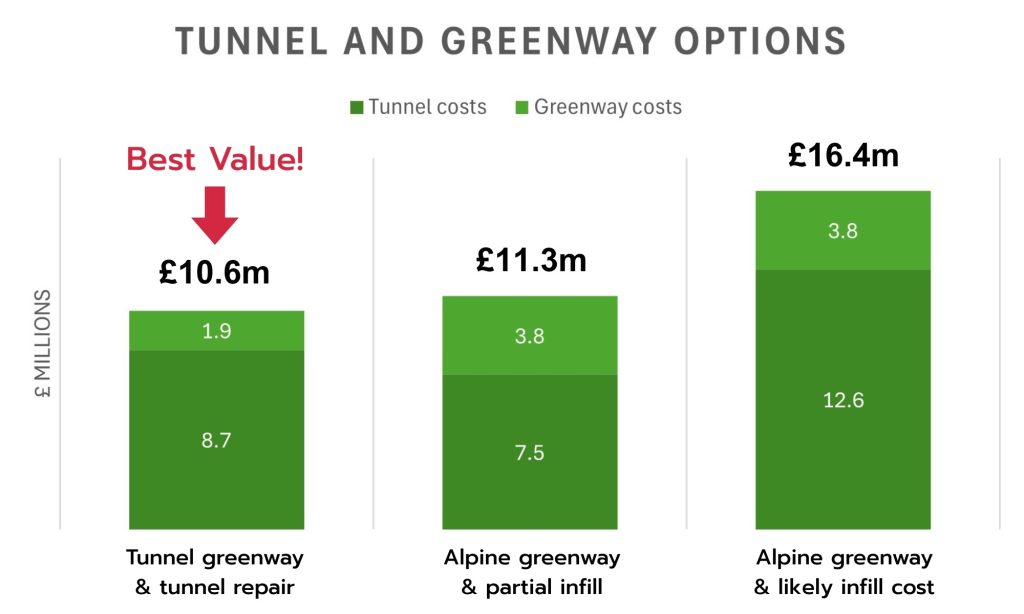
As part of the latest justification for blocking the tunnel, ministers claim there are “less costly greenway options” that don’t use the tunnel. However, a study by Sustrans (now Walk Wheel Cycle Trust) found the alternative ‘Alpine’ (surface) route to be “highly compromised”. It involves extended and steep climbs, would take people on-road through the junction of two busy A-roads, and would cost over £3.8 million to construct.
By contrast, the tunnel route would be half the length of the ‘Alpine’ route, flatter, more likely to attract users, and cost only £1.9 million to deliver after the tunnel was repaired. However, this hasn’t stopped ministers pushing the lie that the tunnel option would be more expensive. At one point they were claiming that the £36 million cost of developing a comprehensive greenway network across West Yorkshire was a reason why the tunnel greenway was too expensive. Given that cost has little to do with a greenway through the tunnel, apart from linking to it, this was clearly nonsense.
When the government now says the tunnel route is more expensive it’s because they are including the remedial work needed on the tunnel in the total. Yet they are ignoring the cost of blocking up the tunnel permanently, something they would need to do to justify pursuing a compromised surface route. When you add everything up you find that restoring the tunnel and building a greenway through it is the cheapest of all the options.
Sustrans also found that transforming the tunnel into a greenway would deliver £3 in social, economic and tourism benefits for every £1 spent, representing high value-for-money. The benefits would amount to £4 per £1 spent if the tunnel was repaired proportionately. This is far greater than many road projects the government has recently committed to, and at a fraction of the cost. So why is the government so resistant to restoring the tunnel?
Local community come together
Despite such a lengthy battle, the Queensbury Tunnel Society has done incredibly well to keep local people interested and involved in the campaign. After its victory in 2021 though, there has been little activity. So when the threat of infilling reared its ugly head again, they were unsure if the local communities still cared passionately about it.
Their concerns were misplaced though, as on a cold, damp and misty afternoon in January 2026, over 200 people gathered at the northern tunnel portal to demonstrate their support. Two local Labour MPs, Judith Cummins and Naz Shah, attended and spoke at the rally, as did Green and Labour councillors and local cycling campaigners.
Government ministers being misled
The worrying aspect of this latest attempt to permanently infill the tunnel and put it beyond use is the way that the public is being deliberately misled. Statements by government Ministers have been factually inaccurate, making claims, in some instances that were blatantly untrue. This is unacceptable and it has been incredibly disappointing to see Ministers take at face value the advice from National Highways and civil servants, given their previous in this area.
The future of Queensbury Tunnel
The Queensbury Tunnel Society has done an excellent job to get this far. Grant Shapps’ intervention in 2020 should have been the end of it, with money being spent to make the tunnel safe for future use. With local people and politicians backing the campaign and the strong evidence for creating a greenway, it is disappointing National Highways was able to hoodwink the new Labour government into agreeing to block up the tunnel.
This affects everyone
While this tunnel is situated in West Yorkshire, the implications for the many thousands of other historical railway assets that could benefit active travel or heritage railways could be at risk. That’s why the society is asking people to write to their MP, wherever they live in the country, urging them to stop Labour from being the ‘blockers’ to their greenway vision.
JOIN OUR NETWORK
Signing up will allow you to access our monthly newsletter and the latest actions and events